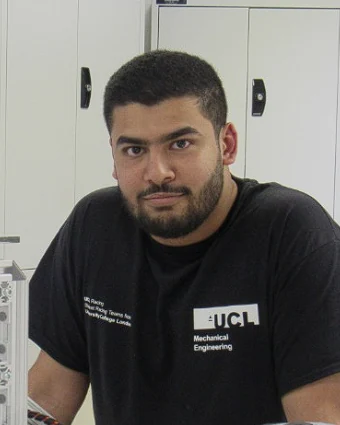
Yusuf Khan

Mechanical Engineer · MEng (Hons), UCL

Mechanical design engineer with practical experience in composites, testing and team leadership.

I take components from CAD through analysis, manufacture and test. My work includes airless wheels and carbon fibre suspension components for a Mars rover, the hull, wing sail and control electronics for an autonomous sailing vessel, and active control research on a hydrogen combustor.

Yusuf Khan in a UCL Mechanical Engineering workshop, seated behind the rover chassis
Degree
MEng Mechanical Engineering, University College London, 2026. Upper Second Class Honours, Nanotechnology minor.
Focus
Mechanical design, composite structures, test and validation
Software
Fusion 360, SolidWorks, CATIA V5, ANSYS, ABAQUS, KiCad, Python, MATLAB
Location
London. Open to relocation within England.
Availability
Available immediately
29core team members led as Team Lead of UCL Rover
15%reduction in redesign time from the CAD review process I introduced
800+students using the workshop systems I designed and deployed

Selected projects

Engineering projects

Four projects covering design, analysis, manufacture and test, from a university competition team to industry-partnered research and a personal build. Select any image to enlarge it.

The rover during outdoor testing, running on the airless TPU wheels.
Airless TPU wheel design, produced by SLS with Xometry.
Suspension and wheels on uneven ground.
Six degree of freedom robotic arm.
The quadcopter, with the rover behind.

UCL Rover2023 to 2026Design Engineer, Team Lead, Drone Lead

Mars Rover for the European Rover Challenge

UCL Rover designs and builds a Mars rover to compete in the European Rover Challenge. The vehicle must traverse rough terrain, collect samples and complete set tasks, with every subsystem designed and manufactured by students to a fixed deadline.

Key contributions

  • Co-designed an airless TPU wheel with the mechanical structures team, consulting Xometry engineers as part of UCL Rover’s sponsorship. The airless design removes the risk of punctures. Six wheels were produced by SLS powder bed printing.
  • Designed the carbon fibre differential bar for the suspension, using FEA to size the part and CNC machining a high-density foam mould for the layup.
  • Designed a six degree of freedom robotic arm as part of the arm and chassis team.
  • As Team Lead, managed 29 core members across seven subteams and introduced a CAD design review process that reduced redesign time by 15%.
  • Led the design and build of the team’s quadcopter from concept to flight test, using FEA to assess its vibration response under motor loading.

OutcomeThe team missed qualification for ERC 2025 by 12 points. Our preliminary proposal and video both scored highly, but the written report was the weakest of the three deliverables. The lessons I have taken forward are to keep refining a design once it reaches a workable state rather than stepping back from it, and to give written deliverables the same rigour as the hardware.

  • Fusion 360
  • FEA
  • SLS (TPU)
  • Carbon fibre layup
  • CNC machining
  • Design review
The completed vessel before lake testing (left) and on the water with the full system installed (right).
CAD model with the self-trimming wing sail and tail vane.
Control PCB designed in KiCad and manufactured by JLCPCB.
GZ curve against wind heeling arm, 0 to 180 degrees of heel.
Wing sail lift coefficient against angle of attack, at Reynolds numbers from 30,000 to 150,000.

MEng group design project2025 to 2026Hull, wing sail and control system design

Autonomous Sailing Vessel for the Microtransat Challenge

The Microtransat Challenge calls for an uncrewed sailing vessel capable of crossing the Atlantic autonomously. The design must be efficient, structurally sound and self-righting, with an autopilot that operates without intervention.

Key contributions

  • Developed the hull geometry using CFD and FEA against drag and structural load criteria.
  • Manufactured the hull by 3D printing it in sections, assembling them and laying up fibreglass over the exterior with resin to waterproof the structure.
  • Designed and developed a self-trimming wing sail, using a tail vane to set the wing’s angle of attack to the wind.
  • Produced the stability documentation, including GZ curves against wind heeling arm, an inclining test load case and a mass budget.
  • Designed the control PCB in KiCad, manufactured by JLCPCB. It integrates the microcontroller, IMU, GPS, radio, encoders, servo outputs and power regulation.
  • Wrote all control and autonomy software, including a cascaded PID autopilot, waypoint planning and tracking, and power management.

OutcomeLake tested with the full system installed. Both remote-controlled sailing and autonomous waypoint following were successful.

  • CFD
  • FEA
  • 3D printing
  • Fibreglass layup
  • KiCad
  • Teensy 4.1
  • C++
  • RFM95W LoRa
  • INA226
  • PID control

Industry-partnered research

Images and detailed data from this project are confidential under a non-disclosure agreement with the industry partner.

Individual research project, UCLWith an industry partner2024 to 2025

Active Control of Thermoacoustic Instability in a Hydrogen Combustor

Investigated thermoacoustic instability in a model hydrogen gas turbine combustor with an industry partner.

Key contributions

  • Instrumented the test rig.
  • Developed a dual-loop active control system in LabVIEW.
  • Processed and analysed the test data in Python and MATLAB.

OutcomeThe control strategy achieved a measurable reduction in instability across the operating conditions tested.

  • LabVIEW
  • Data acquisition
  • Pressure transducers
  • Python
  • MATLAB
The complete engine assembly in Fusion 360.
Front section through the pistons, connecting rods and crank.
Section through one of the four turbochargers.

Personal projectOngoing

Quad-Turbocharged V12 Engine: Design and Scale Model

An independent project to design a quad-turbocharged V12 engine and build it as a working scale model, undertaken to develop a detailed understanding of high-performance engine architecture.

Key contributions

  • Defined the engine layout and the arrangement of the four turbochargers.
  • Modelled the complete assembly in Fusion 360 with kinematic joints, so the rotating and reciprocating components move as they would in operation.
  • Building a scale model from plywood, acrylic and 3D printed components, designing each part for the process used to make it.

StatusThe block and camshaft banks have been laser cut and assembled, and the camshafts, valves, crankshaft and pistons 3D printed and fitted. Next are the cylinder bores, turbochargers and pipework, followed by the electronics.

  • Fusion 360
  • Kinematic joints
  • Laser cutting
  • 3D printing

Software and embedded systems

Systems in daily use

Alongside mechanical work, I design and maintain software and embedded systems, including tools used daily in MechSpace, the UCL Mechanical Engineering student workshop.

MechSpace, UCLPython, Raspberry Pi, Linux

Workshop Sign-In System

A barcode-based sign-in system that records workshop attendance and displays current occupancy on a kiosk screen.

The system originally ran on a Windows PC that intermittently failed overnight. I traced the fault through the event logs to scheduled update restarts, then migrated the system to a Raspberry Pi. The redesign reads the scanner directly at device level, runs each process as a managed service that restarts automatically on failure, and backs the records up to cloud storage.

  • Python
  • evdev
  • systemd
  • rclone
  • Raspberry Pi
The sign-in kiosk at the workshop entrance.

System overview

  1. Barcode scanA student scans their card at the USB scanner.
  2. Device-level inputThe scanner is read directly through evdev, independent of window focus.
  3. Sign-in logicThe Python service records the student as signed in or out.
  4. RecordsA full visit log and a live occupancy list are written to CSV.
  5. Backuprclone copies the records to Google Drive every ten minutes and nightly.

A kiosk display shows current occupancy, and systemd restarts any process that stops.

The component catalogue, with live stock levels and credit prices.
Equipment loans for hand tools and iPads.
The credit ledger. Student names are hidden.

MechSpace, UCLPython, Notion API, HTML and JavaScript

StockSHOP Self-Checkout

A self-checkout system for the workshop stockroom, built on the Notion API.

Students search the catalogue and check components out against a credit allowance, with separate budgets for the UCL racing teams, a full transaction ledger and CSV export. The system also manages loans of hand tools and iPads, and a companion display shows which mentors are on shift.

  • Python
  • Notion API
  • HTML and JavaScript

3D Printer Network

A Raspberry Pi router that connects to the university network and provides a dedicated wireless network for the workshop’s 3D printers.

  • Raspberry Pi
  • RaspAP
  • Linux networking

Embedded Game Console

A two-player game built on an Arduino Uno with an OLED display and analogue inputs, including hardware fault-finding on the reset circuit and an input pin shared with the I²C bus.

  • Arduino
  • C++
  • Electronics

Experience

Leadership and roles

Engineering, leadership and teaching roles held alongside my degree.

  • Sep 2025 to Aug 2026

    Drone Lead

    UCL Rover

    Led the design and build of the team’s quadcopter from concept to flight test, using FEA to assess its vibration response under motor loading.

  • Aug 2024 to Aug 2025

    Team Lead

    UCL Rover

    Led a 29-member core team across seven subteams for the European Rover Challenge 2025. Coordinated the mechanical, electrical and software subteams, presented at design reviews and introduced a CAD design review process that reduced redesign time by 15%.

  • Sep 2023 to Aug 2024

    Robotic Arm and Chassis Design Engineer

    UCL Rover

    Designed the six degree of freedom robotic arm and chassis components, including the carbon fibre suspension differential bar.

  • Feb 2024 to Aug 2026

    CAD and Fabrication Mentor

    MechSpace, UCL

    Trained students in CAD, additive manufacturing and CNC machining, and maintained workshop equipment. Designed and deployed the workshop’s sign-in and stock management systems, and delivered STEM Racing workshops for school groups.

  • 2020 to 2026

    Private Tutor

    Bright inTuition

    Tutored GCSE Mathematics and A-level Mathematics, Further Mathematics, Chemistry and Physics.

Skills and education

Technical skills and qualifications

CAD
Fusion 360 (advanced), SolidWorks, CATIA V5; kinematic joints, 2D detail drawings, design for manufacture
Analysis
FEA (ANSYS, ABAQUS), CFD, stability and hydrostatics
Manufacture
Carbon fibre and fibreglass layup, mould-making, CNC machining, additive manufacturing, laser cutting
Electronics
PCB design (KiCad), Teensy and Arduino, sensor integration
Test and control
LabVIEW, data acquisition, pressure transducers, PID control
Programming
Python, MATLAB, C++, Linux on Raspberry Pi
Leadership
Team leadership, design reviews, project planning, teaching
In development
GD&T and tolerance stack-up analysis to ASME Y14.5-2018

MEng Mechanical Engineering

University College London · 2022 to 2026
Upper Second Class Honours, Nanotechnology minor

Selected modules
Data-Driven Methods for Engineers84.8
Advanced Thermodynamics and Fluid Mechanics79.5
Introduction to Nanotechnology78.2
Manufacturing and Design75.8
MEng Capstone Group Design Project70.4

Marks out of 100. 70 and above is first-class standard.

A-Levels

Brampton Manor Academy · 2020 to 2022

Mathematics (A*), Further Mathematics (A), Physics (A), Chemistry (A)

Contact

Get in touch

I am seeking a graduate role in mechanical or design engineering and am available to start immediately. I am based in London and open to relocation within England.

Email
yusufreza10117@gmail.com
LinkedIn
linkedin.com/in/yusuf-khan-78a545268
CV
Yusuf_Khan_CV.pdf